What Is the 7 3 2 1 Study Method? Complete Guide
The 7‑3‑2‑1 study method is a spaced repetition technique.
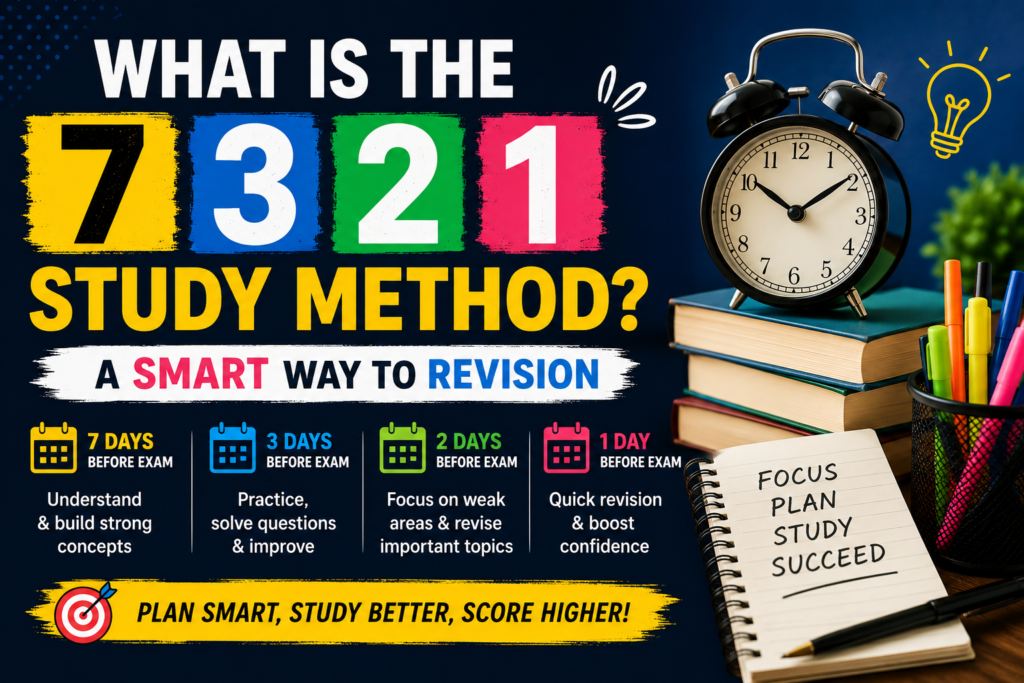
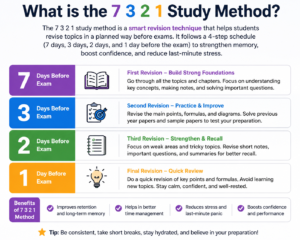
You study a topic once, then review it again after specific gaps in time: 7 days, 3 days, 2 days, and 1 day before the test or before you want to “lock in” the knowledge.
One common way people use it is:
-
First study: the day you learn the topic
-
First review: 7 days after learning
-
Second review: 3 days after that
-
Third review: 2 days after that
-
Final review: 1 day before the test or deadline
The idea: each review strengthens your memory, and the increasing frequency near the exam reduces the need for last‑minute cramming.
How the 7‑3‑2‑1 method works step by step
Imagine you learned “Chapter 5: Cell Division” on 1 June.
You could apply the 7‑3‑2‑1 method like this:
-
Day 0 – Learn the material deeply
-
Read the chapter slowly.
-
Underline or highlight key ideas.
-
Write 5–10 short notes in your own words.
-
Make 3–5 simple questions you could test yourself on later.
-
-
7 days later – First review
-
On 8 June, open only your notes and questions.
-
Before reading, try to recall everything from memory.
-
Then check your notes to see what you missed.
-
Add or update any confusing points.
-
-
3 days later – Second review
-
On 11 June, do a quick, active review:
-
Try to explain the topic out loud as if teaching a friend.
-
Answer the questions you wrote earlier without looking.
-
-
-
2 days later – Third review
-
On 13 June, test yourself again:
-
Use flashcards.
-
Do practice questions or past‑paper problems for that chapter.
-
-
Focus only on parts you still forget.
-
-
1 day later – Final review
-
On 14 June, the day before your test:
-
Do a short recap (15–30 minutes).
-
Look at summaries, diagrams, formulas, and your “weak spots”.
-
-
By this point, you have seen the same topic 5 times, but without studying it for hours every day. You are training your brain to remember over the long term, not just for one night.
Why the 7‑3‑2‑1 study method works
This method works because of three powerful learning principles:
-
Spaced repetition
Your brain remembers better when you see the same information again after some time, not when you repeat it 10 times in one day. -
Active recall
Each review is not just rereading; you pull the information from your memory (through quizzes, explaining, or teaching). This “mental effort” makes the memory stronger. -
What Is the 7 3 2 1 Study Method? Complete Guide….. Reduced forgetting curve
Normally, you forget a lot of what you study within a few days.
By reviewing at 7‑3‑2‑1 intervals, you interrupt this forgetting and push the information into long‑term memory.
How to use the 7‑3‑2‑1 method in real life
Here is a simple way to apply it to your subjects:
1. Break content into topics
Instead of saying “I will study all of physics”, break it into small chunks, for example:
-
Kinematics
-
Newton’s Laws
-
Work, Energy, Power
-
Momentum
-
Circular Motion
You will run the 7‑3‑2‑1 cycle separately for each chunk.
2. Use a planner or calendar
Take each topic and schedule your reviews:
-
Write the first study date.
-
Count forward 7 days, 3 days, 2 days, 1 day.
-
Mark those review days in your calendar (digital or paper).
For example:
-
1 June: First study – Newton’s Laws
-
8 June: 7‑day review
-
11 June: 3‑day review
-
13 June: 2‑day review
-
14 June: 1‑day review
Do this for every topic you care about.
3. Keep each review short and focused
You do not need to study 2–3 hours in every review. Instead:
-
First study: maybe 45–60 minutes
-
7‑day review: 20–30 minutes
-
3‑day review: 15–20 minutes
-
2‑day review: 15–20 minutes
-
1‑day review: 10–15 minutes
If you are preparing for many subjects, this keeps your workload realistic.
Tips to make 7‑3‑2‑1 more powerful
To really benefit from this method, combine it with good study techniques:
-
Use active recall in every review
-
Cover your notes and try to write or say everything you remember.
-
Do practice questions before reading theory.
-
Explain the topic to an imaginary friend or to yourself.
-
-
Use simple tools
-
Flashcard apps (e.g., for definitions and formulas).
-
A notebook where you write “7‑3‑2‑1 schedule” for each chapter.
-
A wall calendar with color codes for each subject.
-
-
Focus on your weak points
-
During every review, mark what you still find confusing.
-
Spend extra minutes only on those points next time.
-
This prevents wasting time on things you already know well.
-
-
Combine with other methods
-
Pomodoro (25–5) for longer sessions, and 7‑3‑2‑1 for long‑term planning.
-
Mind maps or diagrams for visual subjects.
-
Past papers for exam‑style practice in the later reviews.
-
Example: Using 7‑3‑2‑1 for an exam
Suppose your exam is on 30 June, and you want to use the 7‑3‑2‑1 method for “Photosynthesis” in Biology.
You could work backwards:
-
29 June: Final 1‑day review
-
27 June: 2‑day review
-
24 June: 3‑day review
-
17 June: 7‑day review
-
10 June: First deep study of photosynthesis
So your plan is:
-
10 June – Learn the topic (read, take notes, make questions)
-
17 June – Review notes and test recall
-
24 June – Teach the topic out loud, answer questions without notes
-
27 June – Past‑paper questions on photosynthesis
-
29 June – Quick recap of key diagrams, definitions, and common mistakes
You will go into the exam with the topic fresh and strong in your mind.
The What Is the 7 3 2 1 Study Methodis a simple revision strategy that helps students remember what they learn for a longer time. Instead of reading everything once and forgetting it, you review the same topic several times on different days. This method is based on spaced repetition and active recall, two science‑backed techniques that improve long‑term memory. With a clear plan, you can study smarter, not harder, and feel more confident before exams.
To use the What Is the 7 3 2 1 Study Method, you first study a topic deeply on day one and then review it again after 7 days, 3 days, 2 days, and 1 day. Each review session is shorter than the first, focusing only on key points, formulas, and questions. By spacing out your revision like this, your brain gets repeated reminders of the same information, making it easier to recall later. This structure also stops you from doing last‑minute cramming the night before the test.
One of the biggest benefits of the 7 3 2 1 study method is that it turns revision into a clear schedule instead of a stressful guessing game. You always know what to review and when to review it. Students can combine this method with tools like flashcards, mind maps, and past papers to make each review session active and engaging. Over time, this routine builds strong study habits and reduces exam anxiety.
what Is the 7 3 2 1 Study Method works for almost any subject, including science, maths, languages, or history. You can adapt it to your own timetable by planning your reviews in a diary or digital calendar. Even if you are busy, short 10–20 minute sessions at the right time can make a big difference to your memory. By following this pattern for each chapter or topic, you create a powerful, organized way to prepare for tests and long‑term learning.
Now your turn: in one or two sentences, how would you explain the 7 3 2 1 study method to a classmate who has never heard of it?