Mindset: How to Build Self-Awareness, Confidence and Better Thinking Habits
You can study for hours and still feel that something is holding you back.
Maybe you overthink simple decisions. Maybe you compare yourself with other students. Maybe one bad result makes you question your ability. Or perhaps you know what you should do, but your thoughts keep getting in the way.
This is where mindset matters.
Your mindset does not magically solve your problems. It changes how you interpret those problems, how you respond to failure and what actions you take next.
A strong mindset is not about being positive all the time. It is about understanding yourself, thinking clearly, handling difficult situations and choosing useful actions even when you don’t feel confident.
For students, this can make a major difference in studies, communication, relationships, career decisions and personal growth.
Let’s understand how to build it practically.
What Is Mindset?
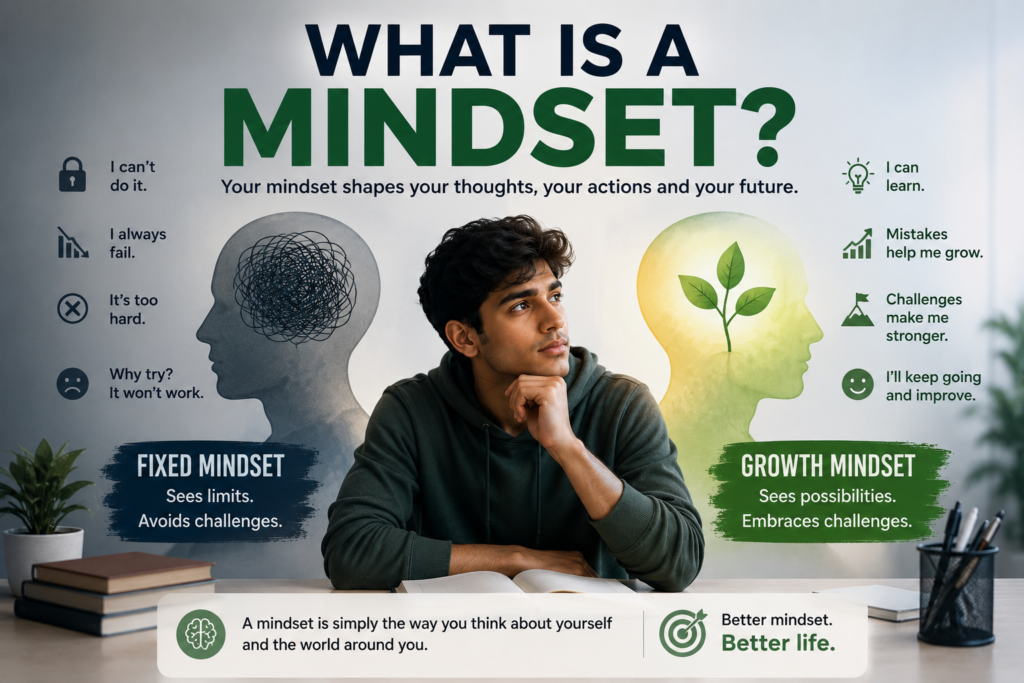
Mindset is the way you generally think about yourself, your abilities, challenges, failures and opportunities.
For example, imagine two students receive low marks in an exam.
One thinks:
“I’m just not good at this subject.”
The other thinks:
“My preparation method didn’t work. I need to understand what went wrong.”
The situation is the same, but their interpretation is different.
That interpretation influences their next action.
A useful mindset does not mean pretending everything is fine. It means learning to look at situations honestly without immediately turning them into negative conclusions about yourself.
Mindset Is Not Just Positive Thinking
Positive thinking can be useful, but mindset is much broader.
A healthy mindset helps you:
- Understand your emotions.
- Question negative assumptions.
- Accept mistakes without defining yourself by them.
- Handle criticism.
- Take responsibility for your actions.
- Build confidence through action.
- Learn from failure.
- Make better decisions.
The goal is not to think positively about everything.
The goal is to think more accurately and respond more effectively.
Why Mindset Matters for Students
Student life comes with constant comparison and uncertainty.
You may compare your marks with your classmates, your English with someone else’s, your career progress with a friend’s or your appearance with people you see online.
If you don’t understand your own thinking patterns, comparison can slowly damage your confidence.
A healthier mindset helps you separate:
What happened from what you think it means.
For example:
Fact: “I scored 55%.”
Interpretation: “I’m a failure.”
The first statement is information.
The second is a conclusion.
Learning to identify this difference is a powerful thinking habit.
1. Build Self-Awareness First
Before changing your mindset, understand your current one.
Self-awareness means noticing your thoughts, emotions, habits and reactions without immediately judging yourself.
Ask yourself:
- What situations make me insecure?
- When do I overthink the most?
- What kind of criticism affects me deeply?
- What do I usually tell myself after making a mistake?
- Which people make me compare myself?
- What situations make me confident?
- What habits repeatedly create problems for me?
You don’t need to answer everything in one sitting.
Start by observing yourself for seven days.
The 3-Minute Self-Awareness Exercise
At the end of each day, write:
1. What happened?
Describe the situation objectively.
2. What did I think?
Write your immediate thought.
3. What did I do?
Write your reaction.
For example:
Situation: I had to speak English in class.
Thought: Everyone will laugh at my English.
Action: I avoided speaking.
Now you can see the pattern.
The problem may not simply be “poor English.”
It may also be the fear of being judged.
Once you can see the pattern, you can start changing it.
2. Learn to Separate Facts From Thoughts
One of the most useful thinking habits is learning to distinguish reality from your interpretation of reality.
Consider this:
“My friend didn’t reply to my message. They must be angry with me.”
What do you actually know?
You know that your friend hasn’t replied.
You don’t know why.
They could be busy, tired, offline or dealing with something else.
Your brain filled the information gap with a conclusion.
This happens frequently with overthinking.
Try the Fact vs Story Method
Whenever you notice yourself worrying, create two columns:
| Fact | Story |
|---|---|
| I haven’t received a reply. | They are ignoring me. |
| I made one mistake. | I’m bad at everything. |
| I scored low marks. | I’ll never succeed. |
| Someone criticized my work. | Nobody respects me. |
Then ask:
“What evidence do I actually have?”
This simple question can stop many unnecessary mental loops.
3. Build Confidence Through Evidence
Many people wait for confidence before taking action.
That is often backwards.
Confidence usually becomes stronger after you repeatedly take action and prove to yourself that you can handle it.
For example, if you want to improve your English communication, don’t wait until you feel confident.
Start speaking.
You may make mistakes.
Then learn from those mistakes.
Speak again.
Gradually, your brain collects evidence:
“I can speak even when I’m nervous.”
That is more useful than simply repeating:
“I am confident.”
The Confidence Loop
Action → Experience → Evidence → Confidence → More Action
This is why small challenges matter.
Try:
- Asking one question in class.
- Speaking English for five minutes daily.
- Going to the library alone.
- Starting a difficult assignment without waiting for motivation.
- Saying no when necessary.
- Sharing your opinion respectfully.
Small actions create evidence that changes how you see yourself.
4. Stop Using One Failure to Define Yourself
A common mindset mistake is turning an event into an identity.
For example:
“I failed an exam, so I’m a failure.”
But failing an exam and being a failure are not the same thing.
A better interpretation is:
“I failed this exam. Now I need to understand why.”
Maybe your preparation was inconsistent.
Maybe you used ineffective study techniques.
Maybe you started too late.
Maybe you misunderstood the syllabus.
The purpose of self-reflection is not to blame yourself.
It is to identify what can be improved.
Replace Identity Statements With Process Statements
Instead of:
“I’m bad at studying.”
Try:
“My current study system isn’t working.”
Instead of:
“I’m not confident.”
Try:
“I need more practice in situations where I feel nervous.”
Instead of:
“I’m lazy.”
Try:
“I struggle to start tasks when they feel overwhelming.”
This small change makes problems easier to solve.
5. Develop a Growth-Oriented Mindset
A growth-oriented mindset means seeing abilities as things that can improve through learning, practice and better strategies.
It doesn’t mean everyone can achieve everything simply by trying harder.
Your circumstances, resources, natural abilities and opportunities matter.
But your current level does not automatically determine your future level.
For students, this distinction is important.
If you struggle with mathematics, English or public speaking, don’t immediately conclude:
“I’m not made for this.”
Ask:
“What exactly am I struggling with, and what skill do I need to develop?”
This turns a vague identity problem into a specific learning problem.
6. Control Your Mental Environment
Your mindset is influenced by what you repeatedly consume.
If you spend hours watching short videos, comparing yourself with strangers and consuming negative content, your attention and emotional state can be affected.
This doesn’t mean you need to delete every social media app.
Instead, become intentional.
Ask:
- What am I consuming every day?
- Does it teach me something?
- Does it inspire useful action?
- Does it make me compare myself unnecessarily?
- How much time am I losing to it?
Your mental environment includes:
People + Content + Conversations + Habits + Information
Improve these gradually.
7. Practice Better Self-Talk
Everyone talks to themselves internally.
The problem is that many students speak to themselves in ways they would never speak to a friend.
Imagine your friend makes one mistake and says:
“I’m useless.”
You would probably tell them:
“One mistake doesn’t define you.”
Give yourself the same level of fairness.
This doesn’t mean making excuses.
Instead of:
“I’m useless.”
Say:
“I made a mistake. What can I learn from it?”
Instead of:
“I’ll never be good at this.”
Say:
“I’m currently struggling with this skill.”
The second statement creates room for action.
8. Use the THINK Framework
When you feel confused, insecure or stuck in overthinking, use this simple VichaarVibe framework.
T — Take a Pause
Don’t immediately react to the thought.
Take a few seconds.
H — Hear the Thought
Identify what your mind is actually saying.
“Everyone is ahead of me.”
I — Investigate
Ask:
“Is this completely true?”
Look for evidence.
N — Narrow the Problem
Turn the vague worry into one specific problem.
Instead of:
“My life is going nowhere.”
Ask:
“What is the one thing I need to improve this month?”
K — Keep One Action
Choose one practical action.
For example:
“I will spend 30 minutes every evening improving my English communication.”
The purpose of the framework is simple:
Don’t let an emotional thought automatically become a decision.
9. Don’t Confuse Thinking With Progress
One of the biggest mindset traps is spending too much time thinking about improving without actually doing anything.
You can watch 20 productivity videos.
You can create five study schedules.
You can read books about confidence.
But none of this matters much if you don’t act.
There is a difference between:
Thinking about change
and
Practising change.
If you want confidence, practise uncomfortable situations.
If you want discipline, complete tasks when you don’t feel like doing them.
If you want better focus, practise focused work.
If you want better communication, communicate.
Your mindset changes faster when your actions give your brain new evidence.
10. Learn to Handle Comparison
Comparison is almost unavoidable.
The problem is comparing your complete life with someone else’s highlights.
You may see someone with:
- Better marks.
- Better English.
- Better clothes.
- More followers.
- A better job.
- More confidence.
But you don’t see their full situation.
Instead of asking:
“Why am I behind them?”
Ask:
“What can I learn from them?”
Turn comparison into information.
If someone’s English is better, observe how they communicate.
If someone studies consistently, study their routine.
If someone has better career skills, learn what skills they developed.
Comparison becomes useful when it produces learning instead of self-hate.
11. Create a Weekly Mindset Review
Once a week, spend 15–20 minutes reviewing your thoughts and behaviour.
Ask:
What went well?
Identify situations where you handled yourself well.
What went badly?
Don’t hide mistakes.
What pattern did I notice?
Maybe you procrastinated whenever a task felt difficult.
What did I learn?
Identify the lesson.
What will I change next week?
Choose one behaviour.
This creates a continuous improvement loop:
Observe → Reflect → Learn → Adjust → Repeat
That is much more practical than waiting for a sudden personality transformation.
Common Mindset Mistakes
Mistake 1: Trying to Be Positive All the Time
Ignoring problems doesn’t solve them.
Do instead: Acknowledge the problem honestly and focus on the next useful action.
Mistake 2: Waiting for Motivation
Motivation changes constantly.
Do instead: Build small systems that make action easier.
Mistake 3: Overthinking Self-Improvement
You can become obsessed with learning without implementing anything.
Do instead: After learning one useful idea, immediately apply it.
Mistake 4: Expecting Instant Confidence
Confidence develops through experience.
Do instead: Take small uncomfortable actions consistently.
Mistake 5: Treating Your Current Situation as Permanent
Your current marks, communication skills, habits or confidence level describe your present situation.
They don’t automatically define your future.
Do instead: Ask what skill or behaviour can be improved next.
A Simple 7-Day Mindset Challenge
Day 1 — Observe
Write down three recurring thoughts you had today.
Day 2 — Question
Choose one negative thought and ask what evidence supports it.
Day 3 — Act
Do one small thing you have been avoiding.
Day 4 — Speak
Express your opinion honestly in one conversation.
Day 5 — Reduce Comparison
Spend less time consuming content that makes you compare yourself.
Day 6 — Reflect
Write three things you learned about yourself this week.
Day 7 — Build
Choose one mental habit you want to continue for the next 30 days.
Don’t try to transform your entire personality in seven days.
The goal is to become slightly more aware and intentional.
Key Takeaways
- A strong mindset is not about fake positivity; it is about thinking clearly and responding effectively.
- Self-awareness is the starting point for changing unhealthy mental patterns.
- Separate facts from the stories your mind creates.
- Build confidence through action and evidence, not just positive affirmations.
- Don’t turn one failure into an identity.
- Use mistakes as information for improvement.
- Your mental environment affects your thinking habits.
- Small actions repeated consistently can gradually change how you see yourself