

How to Focus on Studies and Remember Everything — A Student’s Practical Guide
Meta title: How to Focus on Studies and Remember Everything | Student Study Hacks
Meta description: Struggling to concentrate and retain what you study? Discover simple, science-backed strategies — Pomodoro, Active Recall, Spaced Repetition, Deep Work, and mind maps — to help students focus on studies and remember everything. Practical routines, examples, and a 7-day action plan.
SEO-friendly slug: how-to-focus-on-studies-and-remember-everything
Attention-grabbing headline
How to Focus on Studies and Remember Everything: Simple Science-Backed Habits That Actually Work
Introduction — the relatable problem
You sit down to study with the best intentions, but 30 minutes later you realize you’ve scrolled, snacked, and re-read the same paragraph three times. Exams are coming, and the pressure to remember everything feels impossible. If this sounds like you, you’re not lazy — you’re missing a system. In this post you’ll learn how to focus on studies and remember everything using easy, proven techniques students can start today.
Why this works (quick overview)
-
Focus + method = memory. Short, concentrated effort with active methods beats long passive reading.
-
Science-backed tools we’ll use: Pomodoro, Active Recall, Spaced Repetition, Deep Work, and Mind Mapping.
-
Practical: routines, examples, and a 7-day action plan for immediate results.
How to focus on studies and remember everything — step-by-step
-
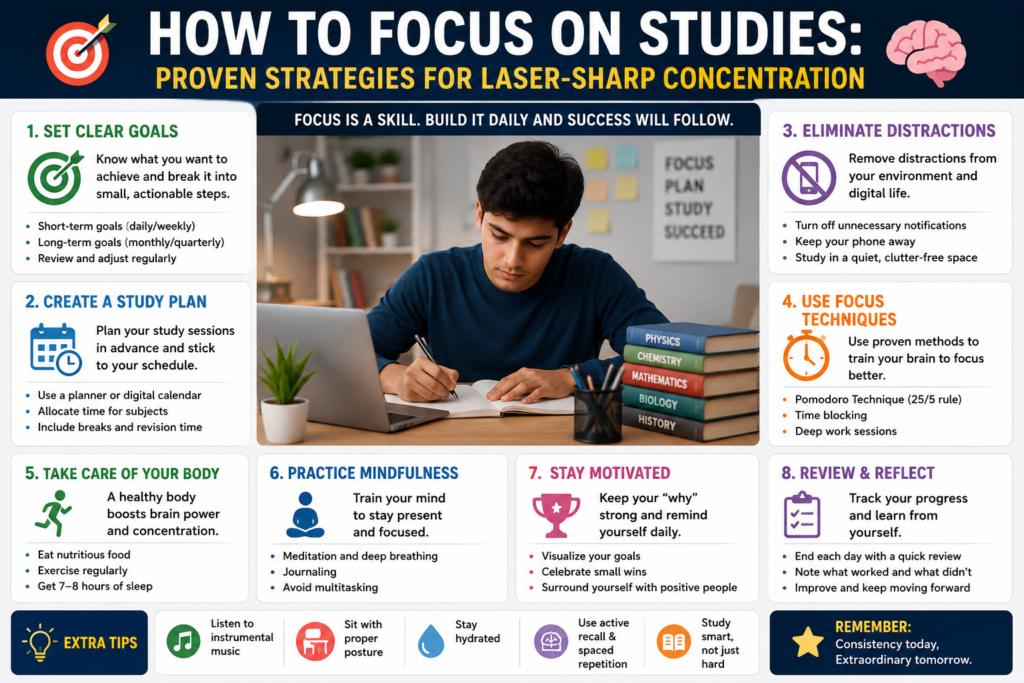
Start with a clear goal (5 minutes)
-
Set one specific outcome per session: “Understand photosynthesis steps” or “Solve 10 math problems.”
-
Write your goal at the top of your page. Specific goals reduce decision fatigue.
-
Build a study-friendly environment
-
Remove distractions: phone on Do Not Disturb and out of sight, unnecessary tabs closed.
-
Create cues: same desk, clean surface, good lighting.
-
Keep only essentials: textbook, notebook, pen, water.
-
Use focused time blocks — Pomodoro Technique
-
Try 25/5 (25 min focus, 5 min break) or 50/10 if you prefer longer stretches.
-
During each Pomodoro, single-task. No phone, no social media.
-
After four Pomodoros, take a 20–30 minute break.
Example routine: -
0–25 min: Read and highlight main ideas.
-
25–30 min: Break (walk, stretch).
-
30–55 min: Active practice — questions or teach-back.
-
Learn actively — Active Recall
-
After reading a section, close the book and write down everything you remember.
-
Turn headings into questions and answer them without notes.
-
Use practice problems, past papers, and flashcards.
Example: After studying a chapter on cell division, write: “List the stages of mitosis and one key event in each.”
-
Lock it in — Spaced Repetition
-
Review the same material at increasing intervals: after 1 day, 3 days, 7 days, 14 days, 1 month.
-
Use spaced-repetition apps (Anki, Quizlet) or a paper calendar.
-
When reviewing, use active recall — don’t just re-read notes.
-
Focus deeply — Deep Work principles
-
Schedule 1–2 deep work sessions daily for your hardest topics, free from interruptions.
-
Protect these times as non-negotiable (early morning or late evening, whichever you’re most alert).
-
Start with 45–90 minute deep work sessions and increase gradually.
Tip: Tell family/roommates your deep work window to reduce interruptions.
-
Organize thinking — Mind Mapping
-
Create visual maps connecting main ideas and subtopics.
-
Use colors, icons, and short phrases. Mind maps make relationships memorable.
-
Build mind maps after initial study; use them before tests for quick review.
-
Memory hacks and techniques
-
Link new info to what you already know (elaboration).
-
Create vivid mental images or silly stories (mnemonics).
-
Chunk information into groups (phone numbers, lists).
-
Use the method of loci (memory palace) for ordered lists.
-
Improve concentration habits
-
Reduce multitasking; practice single-tasking.
-
Train attention with short daily sessions of focused reading or meditation.
-
Use ambient focus music or white noise if total silence distracts you.
-
If concentration drifts, use the “5-minute rule”: work focused for 5 minutes; often you’ll continue.
-
Physical and mental optimization
-
Sleep: 7–9 hours nightly; memory consolidation happens during sleep.
-
Movement: 20–30 minutes of light exercise boosts focus and mood.
-
Nutrition: Eat balanced meals; avoid heavy sugar before study.
-
Hydration: Keep water nearby.
-
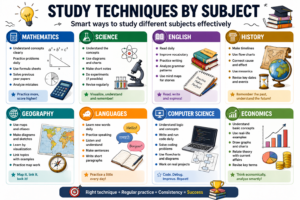
Study techniques by subject
-
Math/Physics: Solve problems before reading solutions; master steps.
-
Languages: Speak aloud, use flashcards for vocabulary, practice retrieval.
-
History: Create timelines and cause-effect mind maps.
Biology/Chemistry: Draw diagrams and explain processes in your own words.
-
How to Focus on Studies and Remember Everything
-
Create a weekly study plan (example)
-
Monday: Deep work on Topic A (90 min), review flashcards (20 min).
-
Tuesday: Practice problems Topic A (60 min), mind map Topic B (30 min).
-
Wednesday: Review spaced repetition cards (30 min), deep work Topic B (90 min).
-
Thursday: Past paper practice (90 min), review notes (30 min).
-
Friday: Teach-back session to a friend or mirror (45 min), relax early.
-
Weekend: Consolidation and long review sessions.
-
Use tools that help (not distract)
-
Anki / Quizlet — spaced repetition flashcards.
-
Forest / Focus To-Do — Pomodoro timers with rewards.
-
Notion / Evernote — organize notes and daily goals.
-
Noise apps: Focus@Will, Noisli, or simple instrumental playlists.
-
Track progress and adapt
-
Keep a short study log: date, topic, time, score/confidence.
-
Review what’s working weekly; tweak session lengths, timing, or methods.
-
Celebrate small wins to build momentum.
Example study session (1-hour)
-
0–5 min: Set goal (what will success look like).
-
5–30 min: Pomodoro 25 min — active study with notes and questions.
-
30–35 min: Break (stretch, hydrate).
-
35–60 min: Pomodoro 25 min — practice problems or teach-back, then quick review.
Common problems and quick fixes
-
Procrastination: Use two-minute starts or commitment devices (study with a friend).
-
Forgetting: Use active recall immediately after learning and spaced repetition afterward.
-
Overwhelm: Break tasks into 20–30 minute chunks.
-
Distractions: Use website blockers during study time.
Here are four short paragraphs (each one clear and student-focused) that include the focus keyword “How to focus on studies and remember everything.”
You’re not alone if your study sessions feel scattered and unproductive. How to focus on studies and remember everything starts with small choices: a clear goal for each session, a tidy study space, and putting your phone out of reach. These simple changes create the right conditions for real concentration.
Next, use time-tested methods like the Pomodoro Technique and Active Recall to make your study time stronger. How to focus on studies and remember everything becomes a lot easier when you replace passive reading with short, focused work blocks and immediate retrieval practice. That combination forces your brain to work and retain information.
Memory improves when you plan reviews using Spaced Repetition and organize ideas visually with mind maps. How to focus on studies and remember everything means scheduling quick reviews after 1 day, 3 days, and a week, and turning dense notes into colorful, connected maps students can scan quickly before exams.
Finally, don’t forget rest, movement, and good sleep—your brain needs recovery to consolidate memories. How to focus on studies and remember everything isn’t about studying harder nonstop; it’s about studying smarter and building sustainable habits that make learning easier and more reliable.
FAQs
Q: How long should a study session be?
A: Quality beats quantity. Start with 25–50 minute focused blocks. For deep work, aim for 45–90 minutes with no interruptions.
Q: Is rereading helpful?
A: Rereading helps familiarity but not recall. Pair reading with active recall and practice to remember better.
Q: How soon should I review material?
A: Review the same day using active recall, then after 1 day, 3 days, a week, and a month (spaced repetition).
Q: What if I can’t focus at all?
A: Start tiny: 5–10 minutes of focused work, remove obvious distractions, and gradually increase. Consider short meditation to train attention.
Q: Can I study while listening to music?
A: Instrumental or low-lyric music can help some students. Test what works for you; if lyrics distract, switch to noise or silence.
Conclusion — strong closing with CTA
Learning how to focus on studies and remember everything isn’t magic — it’s a skill built with simple, consistent habits. Use focused time blocks (Pomodoro), practice active recall, schedule spaced repetition, reserve deep work windows, and map ideas visually. Start small: pick one technique this week and make it a habit. Ready to boost your study results? Pick one session today, use the 25/5 Pomodoro, and apply active recall — then come back and tell me how it went. Want a printable 7-day study planner and flashcard templates I can customize for your subjects? Ask me and I’ll make it.

Pingback: What Is Active Recall? Benefits, Science & Study Techniques