Table of Contents
ToggleWhat Is Active Recall? The Ultimate Study Technique for Indian Students
Introduction
Every student wants to study smarter, score better marks, and remember information for a longer time. Yet many students spend hours reading textbooks, highlighting notes, and watching lectures repeatedly without seeing significant improvements in exam performance.
If this sounds familiar, you are not alone.
Most students in India prepare for board exams, competitive exams, university tests, and government examinations by rereading the same material again and again. While this method feels productive, research shows that passive reading is one of the least effective ways to learn.
This is where Active Recall comes in.
Active Recall is a scientifically proven learning technique that helps students remember information more effectively by forcing the brain to retrieve knowledge from memory instead of simply reviewing it. Students preparing for CBSE board exams, ICSE exams, JEE, NEET, UPSC, SSC, CAT, CLAT, or college semester examinations can significantly improve their learning outcomes by using Active Recall.
In recent years, Active Recall has become popular among top-performing students, medical students, and competitive exam aspirants because it improves memory retention, understanding, and exam performance.
In this detailed guide, you will learn:
- What Active Recall is
- The science behind it
- Benefits for Indian students
- How to implement it step by step
- Common mistakes to avoid
- Frequently asked questions
Let’s begin.
What Is Active Recall?
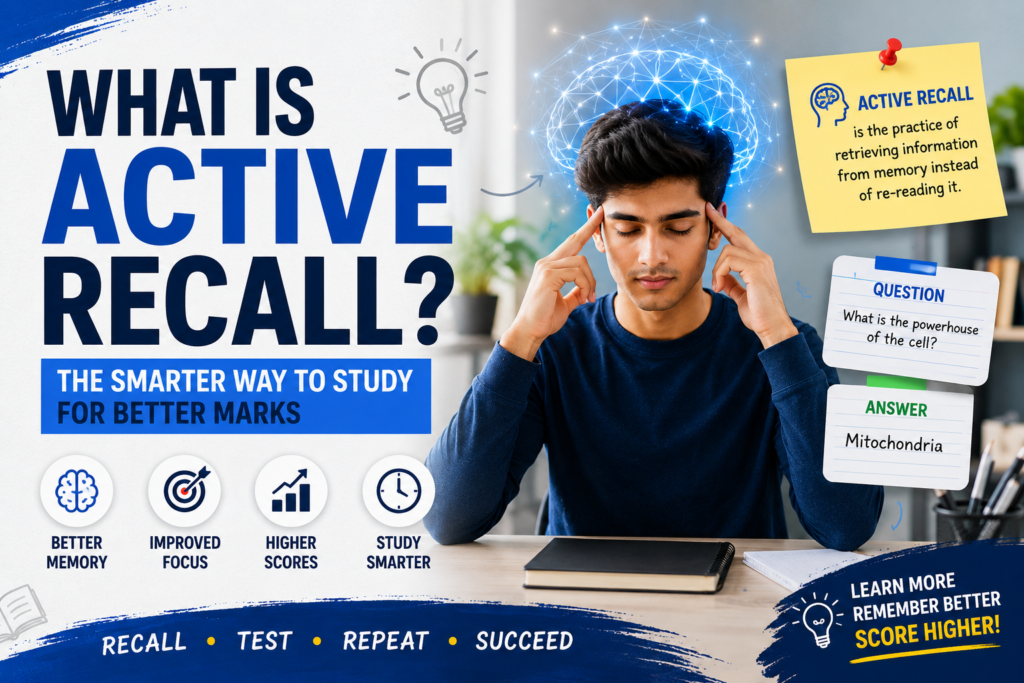
Active Recall is a study technique in which you actively retrieve information from your memory instead of passively reading or reviewing it.
In simple words, Active Recall means testing yourself on a topic without looking at the answer.
For example:
Passive Study Method
A student reads a Biology chapter five times.
Active Recall Method
A student reads the chapter once and then closes the book and tries to answer questions such as:
- What are the functions of mitochondria?
- What is cellular respiration?
- Why is ATP called the energy currency of the cell?
The second method forces the brain to search for information stored in memory. This retrieval process strengthens memory and improves long-term retention.
Simple Definition
Active Recall = Learning by remembering rather than rereading.
The key idea is straightforward:
Instead of asking:
“Have I read this chapter?”
Ask:
“Can I explain this chapter without looking at my notes?”
If you can recall information from memory, you truly know it.
Why Traditional Studying Often Fails
Many students believe that spending more hours with books automatically leads to better marks.
Unfortunately, this is not always true.
Common study habits include:
- Reading notes repeatedly
- Highlighting textbooks
- Underlining important points
- Watching the same lecture again
- Copying notes multiple times
These activities create an illusion of learning.
Students feel familiar with the material because they have seen it several times. However, during exams, they often struggle to remember answers because they never practiced retrieving information.
Examinations do not test whether you recognize information.
They test whether you can recall information.
That is exactly what Active Recall trains you to do.
The Science Behind Active Recall
Active Recall is not just another study tip. It is supported by cognitive psychology and neuroscience.
Researchers have discovered that the act of retrieving information strengthens memory more effectively than reviewing information repeatedly.
This concept is known as the Testing Effect or Retrieval Practice.
What Is the Testing Effect?
The Testing Effect states that people remember information better when they actively retrieve it from memory.
When your brain works to recall information:
- Neural pathways become stronger
- Memory connections become deeper
- Information becomes easier to access later
Each successful retrieval acts like a mental workout for your brain.
Just as muscles grow stronger through exercise, memory becomes stronger through retrieval.
Memory Strengthens Through Retrieval
Many students think memory works like a storage box.
In reality, memory behaves more like a pathway.
Every time you recall information:
- The pathway becomes stronger
- Access becomes faster
- Retention becomes longer
For example:
If you answer a Chemistry question from memory today, tomorrow, and next week, your brain creates stronger retrieval routes.
As a result, recalling that information during the exam becomes easier.
Active Recall Reduces Forgetting
German psychologist Hermann Ebbinghaus introduced the concept of the Forgetting Curve.
His research showed that people forget most newly learned information within a few days if they do not review it.
Active Recall interrupts this forgetting process.
Each retrieval refreshes memory and pushes information back into long-term storage.
This helps students retain concepts for weeks, months, or even years.
Active Recall Creates Deep Learning
When students actively retrieve information, they:
- Analyze concepts
- Connect ideas
- Fill knowledge gaps
- Improve understanding
Instead of memorizing words mechanically, students develop meaningful understanding.
This deeper learning improves both academic performance and practical application.
Benefits of Active Recall for Indian Students
Active Recall offers several advantages, especially for students preparing for academic and competitive examinations.
1. Improves Long-Term Memory
One of the biggest benefits is better retention.
Students often forget information shortly after studying.
Active Recall helps transfer information into long-term memory, making it easier to remember during exams.
For example:
A student preparing for NEET can remember Biology concepts months later if they regularly practice retrieval.
2. Increases Exam Performance
Examinations require recall.
Whether it is:
- CBSE Boards
- JEE
- NEET
- UPSC
- SSC
- CAT
- University exams
Students must retrieve information under pressure.
Active Recall trains the exact skill required during examinations.
As a result, students perform more confidently and accurately.
3. Saves Study Time
Many students spend 8–10 hours studying but achieve average results.
Active Recall increases efficiency.
Instead of reading the same chapter multiple times, students can:
- Read once
- Test themselves repeatedly
This method provides better results in less time.
4. Identifies Weak Areas Quickly
When students test themselves, they immediately discover what they do not know.
For example:
If you cannot explain Newton’s Laws without notes, you know that chapter requires additional revision.
This targeted learning improves productivity.
5. Builds Confidence
Many students enter examinations feeling uncertain.
Active Recall creates confidence because students repeatedly practice remembering information before the actual test.
By exam day, retrieval feels natural.
6. Improves Understanding
Active Recall is not limited to memorization.
Students often discover gaps in understanding when trying to explain concepts from memory.
This leads to deeper comprehension and stronger conceptual clarity.
7. Reduces Last-Minute Stress
Students who rely on cramming often experience anxiety before exams.
Active Recall encourages consistent revision throughout the preparation period.
As a result:
- Less panic
- Better preparation
- Improved confidence
Step-by-Step Guide to Implement Active Recall
Now let us understand how students can practically use Active Recall.
Step 1: Study the Topic Once
Begin by learning the material normally.
You may:
- Read a textbook
- Attend a lecture
- Watch an educational video
- Review class notes
Focus on understanding concepts rather than memorizing every word.
Example:
Read one chapter of Physics carefully.
Step 2: Close the Book
After studying, close all materials.
Do not look at notes.
Now attempt to recall everything you remember.
Ask yourself:
- What was the main topic?
- What formulas were discussed?
- What important concepts were explained?
This retrieval process activates memory.
Step 3: Write Everything From Memory
Take a blank sheet of paper.
Write:
- Definitions
- Formulas
- Diagrams
- Key concepts
- Important facts
Do this entirely from memory.
Do not worry about mistakes.
The goal is retrieval practice.
Step 4: Check Your Answers
Open your notes and compare.
Identify:
- Missing information
- Incorrect answers
- Weak concepts
These areas need additional review.
This feedback loop accelerates learning.
Step 5: Create Questions
Turn notes into questions.
For example:
Instead of writing:
“Photosynthesis converts sunlight into chemical energy.”
Write:
“What is photosynthesis?”
“What is the role of chlorophyll in photosynthesis?”
Question-based learning naturally promotes Active Recall.
Step 6: Use Flashcards
Flashcards are among the most effective Active Recall tools.
Front side:
Question
Back side:
Answer
Example:
Front:
What is Ohm’s Law?
Back:
V = IR
Review cards regularly and attempt to answer before checking.
Step 7: Teach Someone Else
Teaching is powerful Active Recall.
Explain concepts to:
- Friends
- Classmates
- Family members
- Yourself in front of a mirror
If you cannot explain something clearly, revisit the topic.
Step 8: Practice Mock Tests
Mock tests are large-scale Active Recall exercises.
Benefits include:
- Exam simulation
- Faster recall
- Better time management
- Identification of weak areas
Students preparing for competitive exams should take regular mock tests.
Step 9: Combine Active Recall with Spaced Repetition
Spaced Repetition means reviewing information at increasing intervals.
Example:
- Day 1
- Day 3
- Day 7
- Day 14
- Day 30
Combining Spaced Repetition with Active Recall produces excellent retention.
This combination is widely used by top-performing students worldwide.
Best Active Recall Techniques for Students
Question-and-Answer Method
Convert every chapter into questions.
Answer them without notes.
This method works for:
- History
- Biology
- Political Science
- Geography
- Economics
Blurting Method
Study a topic briefly.
Take a blank sheet.
Write everything you remember.
Then compare with notes.
This simple technique is highly effective.
Self-Quizzing
Regularly test yourself.
Examples:
- MCQs
- Short answers
- Fill-in-the-blanks
- Oral questioning
Frequent testing strengthens memory.
Feynman Technique
Choose a topic and explain it using simple language.
Imagine teaching a beginner.
Complex ideas become easier to understand and remember.
Past Year Questions
Previous-year papers naturally encourage Active Recall.
Students retrieve information exactly as required in real examinations.
This is particularly useful for:
- CBSE
- ICSE
- JEE
- NEET
- UPSC
- SSC
Active Recall Examples for Different Subjects
Biology
Question:
What are the functions of the nucleus?
Recall the answer before checking notes.
Mathematics
Question:
How do you solve a quadratic equation?
Attempt the entire process from memory.
Physics
Question:
State Newton’s Second Law.
Write the definition and formula without notes.
Chemistry
Question:
Explain covalent bonding.
Describe the concept independently.
History
Question:
What were the causes of the Revolt of 1857?
List the causes from memory.
English
Question:
Summarize the chapter in your own words.
This strengthens understanding and retention.
Common Mistakes Students Make with Active Recall
Even though Active Recall is powerful, many students use it incorrectly.
Mistake 1: Looking at Notes Too Early
Students often peek at answers immediately.
This defeats the purpose.
Allow your brain time to struggle.
The struggle strengthens memory.
Mistake 2: Rereading Instead of Recalling
Many students claim they are using Active Recall but continue rereading notes.
True Active Recall requires retrieval from memory.
Reading alone is not enough.
Mistake 3: Memorizing Without Understanding
Understanding should come first.
Memorizing without comprehension leads to confusion and rapid forgetting.
Mistake 4: Not Reviewing Mistakes
Errors provide valuable feedback.
Always analyze incorrect answers.
Learn why mistakes occurred.
Mistake 5: Studying Everything Equally
Spend more time on weak topics.
Strong areas require less revision.
Targeted effort produces better results.
Mistake 6: Ignoring Spaced Repetition
One retrieval session is not enough.
Memory strengthens through repeated recall over time.
Schedule regular revision sessions.
Mistake 7: Avoiding Difficult Questions
Students naturally prefer easy topics.
However, growth occurs when challenging weak areas.
Focus on difficult concepts regularly.
Sample Active Recall Study Routine
Here is a practical routine for students.
Morning
- Study a new chapter for 45 minutes
- Perform Active Recall for 15 minutes
Afternoon
- Solve practice questions
- Complete self-quizzes
Evening
- Review previous topics using flashcards
- Practice recall without notes
Weekly
- Take one mock test
- Analyze mistakes
- Revise weak areas
This routine creates continuous retrieval practice.
Frequently Asked Questions (FAQ)
Is Active Recall better than rereading?
Yes.
Research consistently shows that retrieving information improves retention more than passive rereading.
Can Active Recall be used for all subjects?
Yes.
It works effectively for:
- Science
- Mathematics
- History
- Geography
- Economics
- Languages
- Competitive exam preparation
How often should I use Active Recall?
Ideally every study session should include some form of Active Recall.
Even 10–15 minutes can make a significant difference.
Does Active Recall help in board exams?
Absolutely.
Board examinations require students to write answers from memory.
Active Recall directly develops this skill.
Is Active Recall useful for JEE and NEET?
Yes.
Top rankers often use Active Recall because it improves concept retention and problem-solving accuracy.
What is the difference between Active Recall and Spaced Repetition?
Active Recall is the act of retrieving information from memory.
Spaced Repetition determines when you review that information.
Together, they create a highly effective learning system.
Are flashcards necessary?
No.
Flashcards are useful but not essential.
You can practice Active Recall using:
- Blank paper
- Self-testing
- Mock exams
- Teaching others
- Oral questioning
How long does it take to see results?
Many students notice improvements within two to four weeks of consistent practice.
Long-term benefits become more noticeable after several months.
Can college students use Active Recall?
Yes.
It is highly effective for university courses, professional certifications, and competitive examinations.
Is Active Recall suitable for beginners?
Absolutely.
Students of all ages can start using Active Recall immediately with simple self-testing methods.
Conclusion
Active Recall is one of the most effective study techniques available for students today. Unlike passive methods such as rereading, highlighting, or repeatedly reviewing notes, Active Recall strengthens memory by forcing the brain to retrieve information actively.
Scientific research shows that retrieval practice improves long-term retention, increases exam performance, identifies knowledge gaps, and makes studying more efficient. Whether you are preparing for CBSE board exams, JEE, NEET, UPSC, SSC, CAT, college semester exams, or any competitive examination, Active Recall can dramatically improve your learning outcomes.
The process is simple: study a topic, close your notes, test yourself, identify mistakes, and repeat the cycle over time. By combining Active Recall with regular revision and Spaced Repetition, students can remember information longer, understand concepts more deeply, and approach examinations with greater confidence.
The next time you sit down to study, do not ask, “How many pages did I read?” Instead ask, “How much can I remember without looking?” That single change can transform the way you learn and help you achieve better academic results